Image Analysis: Elizabeth and Iconography

In starting this image analysis, it’s been hard to know where to start and with the guideline of “roughly 500 words”, I suppose I better get going and not go into how this image and it’s historical and iconographical significance could easily turn into a graduate dissertation. But—before I get ahead of myself or let my love of iconography get away from me, with an overview of context in mind, let’s begin.

The image I was granted to analyze (and which any forthcoming images, courtesy of 12025508_806365276152327_782360593_nthe Newberry Library, originate in if not otherwise specified) is La Grande Chronique Ancienne et Moderne, de Hollande, Zelande, West-Frise, Utrecht, Frise, Overyssel & Groeningen, Jusques à La Fin de L’ an 1600 [The Grand Chronicle Ancient and Modern of … , just at the end of the year 1600], authored by Jean François Le Petit and printed by Dodrecht in two volumes in 1601. Although I didn’t realize it until after perusing the first volume, this image appears in the second of the two books on page 522.

Before jumping into the image, a bit about the context. The book is written in French, although some of the ‘interlude’ texts (odes, poems, a preface)at the opening of each volume appear in Latin. (And before anything further, although I’ve studied French and basic Latin in my undergraduate career, it is necessary to say that while I can grasp ideas, I relied on online dictionaries for the majority of translations and the result is at best, a broken translation. I digress—) Both volumes begin with the same illustrated plate, the only difference in that of text and designation of “Tome Second” in Vol. II.

This rich plate and it’s references to muses and gods in the Roman tradition as well 12032346_806364622819059_191233875_nas illustrations of a port city, instruments of the arts, war, navigation, and education, and presence of a globe are tantalizing to analyze, but for sake of time and sanity, this overview will continue. The volumes provide a chronicle—and portraitures—of great leaders of the European world. At first glance, the first volume and title would suggest that the focus would be on the titular places around the Dutch world and after perusing the first volume, that all portraitures of influential persons would be of men. To my surprise and pleasure, the image I was assigned is a portraiture of none other then Elizabeth I.

While some may dismiss that Elizabeth’s presence in a chronicle of influential men 12032565_806363462819175_101080419_n (1)would not be unique as she is so often cast as an ‘exceptional feminine’ to succeed in the sphere of men, in this text, she is not the exception as a portraiture of Margaret of Austria precedes her. Another aspect unique in considering this image: the next portrait is of Robert Dudley, whose influence pales in comparison to the rest of those depicted and whose close relationship with Elizabeth—both historically and in this text—is interesting.

A date on the page facing this portraiture places the text as occurring in the year 1585 at the start of the Anglo-Spanish War. Text below the image of Elizabeth Elizabethreferences the conflict and in a rough and brief summary, emphasizes Elizabeth’s protection of England and that the Spanish are not to be feared. Other—French—text that frames the image states “Elizabeth, Queen of England and Ireland, Defendresse [sic] of the Catholics, Protectrice [sic] of the liberty of the Provinces of the Netherlands” (roughly) as well as reference to her as “virginae reginae”—virgin queen. Although—with the close relation between this portraiture and that of Robert Dudley, one begins to wonder if a commentary on that phrase was called into questions by the author, printer, and contemporaneous readers as well as a host of modern historians.

In her portrait, Elizabeth stands in an unspecified space, whereas some other portraits include some reference to a real space with a floor, etc. The Elizabeth shown here is not a young Elizabeth, but one of realistic age—she would have been sixty-six at the time of this book’s production and would die three years later. close up ElizabetaAlthough an image of an older Elizabeth, her images are no less striking than in her younger depictions and her visage is set strong, eyes looking off to the left and given the context of the passage, possibly poised to take in the Spanish armada with a look of resilience and bravery. Her crown is somewhere between an imperial and royal crowns still held in the British crown jewels and inexplicably resembles the coronation orb or ‘globus cruciger’ that she holds, an image that is also mirrored in the pattern and ornamentation of her globe-like skirts. Her dress is ornamental, including the Elizabethan collar of lace that is present in so many of this eras portraits of members of court. Her dress displays brocade and embroidery, jewels, and ribbon ties. At first glance, the sleeves of her dress resemble armor but on closer examination are intricate series of ties and bows—and whose shape has been under discussion as significant by some art historians, especially in contrast to the phallic nature of her scepter and the gender politics of Elizabethan’s rule as not only a woman, but a virgin. (Possibly more on those allusions another time!)

While this image on it’s own is a fascinating one, in the context of this work and the greater iconographical themes that surround depictions of Elizabeth, it joins the greater conversation of a royal and imperial ideology and rule of a feminine ruler in the early modern world.

[images courtesy of the Newberry Library Special Collections]

Bienvenido: un paseo en el barrio de Humboldt Park, Chicago

Monday morning, I participated in an activity that all ACM students are participating in this fall to explore a neighborhood from the perspective of an observer. With two members of my seminar, I set out to the Humboldt Park neighborhood of Chicago. Another group from our program was setting out for humboldtHumboldt Park as well, although we didn’t cross paths again after taking the same eastbound bus on Division Street. To act as a framework of my observations on our adventure, I’ll be using photos to outline our walk. To start, an image of the man and neighboring park that the area borrows the name of.

When we set out on this activity, we were told to hold off on the usual Google searches, micro-Google mapping, and Wikipedia searches that as a member of the app generation, I am accustomed to. I was surprised at how easy it was for me to adapt to not knowing what I was walking into or once there, houses muralwhere to go. We were provided a map that outlined the streets designating the neighborhood boundaries. And, as we got off at a bus stop in the middle of the neighborhood, we began our meandering and by the end of our time, had covered much of the center and north side of Humboldt Park. Our walk wasn’t planned and it wasn’t purposeful that we stuck to this area–with no real agenda beyond seeing the neighborhood, we wandered.

line of streetMajor streets run parallel through the neighborhood–we stuck to North and Division–filled with various businesses, the most abundant being: auto shops, restaurants, so many churches we lost count (both storefront spaces and large chapels on side streets with community centers), ‘supermercados’ and corner stores, liquor stores, and beauty shops. Signs in the neighborhood were written in Spanish, English, or both. An aspeCarnicerias Jimenezct while considering the variation of what signs were not bilingual or in Spanish didn’t occur to me until one of my group pointed it out: all of the city or ‘federal’ signs were in English; none of these were bilingual.

Some businesses were open, some closed with signs of being open later in the Revokedweek and others closed for good. I realized that one of the corner stores advertising groceries clarified the necessities: milk, eggs, pop, cigarettes, and another staple–calling cards. Numerous stores advertised calling cards, especially international calling, which nods to the large immigrant and first or second generation populations in the area. Some shops had barred windows. Spattered around the main streets were a few huge buildings that hearkened back to another time. A behemoth of a National Guard building appeared to still be Pioneer Trust frontin use, but a large bank–Pioneer Trust and Savings Bank–was  vacant; a sign on the door had a vague note about a new branch opening across the street, but there was no date, and no new branch across the way.

Beginning in mid-morning on a Monday, it was interesting to see the bustle of major streets grow over the course of a few hours. It was relatively quiet, even on those main streets earlier in the day. Within the first hour, only one police siren could be heard, something that differs even from the Gold Coast neighborhood. By the time we were finishing up our walk, the main streets were busier, with more traffic and people walking on the streets.

high school flagsAway from these meccas of activity, we explored residential areas down side streets. Of all these streets we walked, every house had a gate. Some lawns were small, if there was any to speak of–all of these were well kept and you could see a sense of pride in houses with beautiful flowers and statues. Flags flew on some porches or Puerto Rican flagwere proudly displayed in windows–we saw flags of Puerto Rico, Mexico, and America. At one high school, we saw these flags as well as a Pan-African flag. Some homes displayed stickers of security companies, neighborhood watch stickers, and others had ‘Beware of Dog’ signs–may it be noted that the only dogs we saw were chihuahuas who looked more wary of us than anything. Chidren’s toys sat in yards or on porches. The homes we passed were single or multi-family homes, but in our walks, we passed possibly 2 large apartment buildings. Although homes had their own fences and security (or at least signs of God Bless Americadeterment) was prevalent, it was apparent that while private, these homes and residential streets are a pride for it’s residents. We saw litter, but none of our group would call the neighborhood “dirty” by any means. The only smells we encountered were what, given the businesses, one could expect: the smell coming from taquerias and walking past an open bay of an auto shop, oil or gasoline.

iglesiaAs we walked the neighborhood, a sense of community was apparent. Different facilities for child care and youth development were available–some connected to churches and others independent. The churches of Humboldt Park were something that stood out, and not only for the sheer number. As we walked the residential streets, it seemed that every third block we would see another church. Many of them had what appeared to be new vinyl signs, although the buildings seemed much older. Reinforcing this sense of pride in one’s heritage, community, and importance of family occurred when we were crossing the street near a church and a younger man–mid 30s, appeared of Hispanic decent, dressed in a shirt and tie–passed us and said “God Bless you, guys” and was the first person to address us. We smiled and as we crossed the street, read the sign next to the church–in both Spanish and English:

This sense of community and importance of ‘good acts’ could be seen in some of the public murals that we saw around the neighborhood, depicting culture, peace, community, and art.

mural 1 mural peace and hope tiled mural

We ended our walk with lunch at a Mexican restaurant near Humboldt Park itself and enjoyed the delicious and as it should be, authentic tacos. We tried to talk to our waitress about the neighborhood when she brought our waters to the table, but she apologized that she couldn’t speak English that well. I wanted to apologize that my Spanish skills were lacking and I’m not sure if she was glad that neither of us attempted to continue the conversation or not. She was very kind and the food was delicious.

As I reflect back on our walk and now that I know more about the neighborhood’s history (in recent years, as a predominantly Puerto Rican and African American neighborhood, although a recent surge of Mexicans and the outward spread of gentrification have begun to hit the neighborhood), I think back to the feeling of walking around the neighborhood. We didn’t feel like intruders that day; no one questioned our being there or even snapping pictures of buildings and signs that on a daily basis, would be completely ordinary. To an extent, I wonder if the local’s perceptions of our group changed anything. I have an olive complexion and dark hair and am often thought to be Hispanic or Latina, so much so that on a recent excursion to Chinatown, someone approached me speaking Spanish and asking for directions. Outwardly, did it look like I “belonged” there? But even typing that, what do we ever mean by that statement, really? While I suppose we’ll never know what people thought of us wandering around a Chicago neighborhood on a Monday morning, I am glad to have had this experience in visiting a neighborhood that without this assignment, I’m not sure I would have ever seen.

I’ll close this post (which has gotten a bit long) with an interesting image that we encountered. The image is just as out of context here as it was on the street we found it. These high end ads were plastered in different places and seemed foreboding of the threat of gentrification in the area and another layer of history and influence becoming a part of this neighborhood’s past.

coach

redecorating my mind palace.

“Research is messy.” Ian remarked during our session this afternoon on learning some electronic tools we’ll be using in our individual research and projects this semester and as it would seem, that remark really struck a chord with me today.

The morning was spent with small groups to do ‘Neighborhood Walks’, an activity that all ACM students studying across the world are participating in this fall. [There will be a post about this coming shortly, so keep an eye out for that sometime over the next few days.] In short, I spent the morning walking around a neighborhood to the west of the Gold Coast and the program digs. Suffice to say, I wasn’t surprised when we were waiting for the bus back after a quick lunch that we had walked around five miles over the course of our meanderings. But more on that some other time.

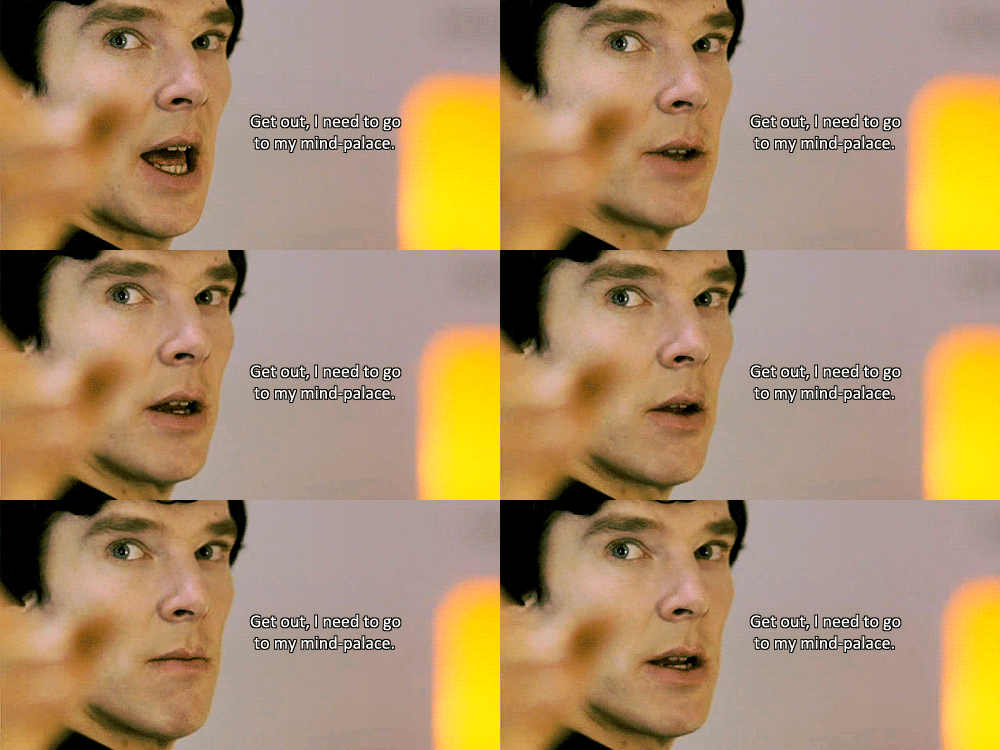
I’m excited to learn to implement these new tools to help organize and on a night like this, I could use a forum to organize my thoughts. As I have written before, I nod to my college’s block plan scheduling in it’s efforts in making a multitasker out of me. But the curse of a multitasker and at times, self-identified overthinker like myself is that with so many ideas and mental catalogs of lists and things to think/write/accomplish at a given time, at times it’s a juggling act to know which ‘to do’ should go back on the shelf for a bit and what to do with a given amount of time. Minds, as I think we all can relate, get cluttered sometimes. Any fans of Sherlock will know the idea of a “mind palace”; tonight I’m thinking mine could do with some redecorating.

My mind palace is a bit full tonight with the reminder of an application’s deadline hanging around like a relative that wish as you may, you can’t quite see to the door. After spending longer than I would like to admit to on an email in regards to an administrative aspect of my application, I felt exhausted. And, 15 minutes later, I got an email back from the mentor I had cc:ed on the email, turns out, the email in question (in which I summarized my interest in the scholarship, personal passions and dreams, and specifics of how the program aligns so closely with my future goals) was…well…not necessary, as the letter would be written by another committee who already had materials to reference. …alrighty, then.

I’m sure there will be many trips back to my ‘mind palace’ and while I’m sure it will always change, tonight my mind is back in a favorite coffee shop near Cornell; the indie music from my Spotify syncs with the typical coffeeshop tunes and a dear friend sits across the table, working on some scientific reading that I will never understand. There’ll be the familiar long drive back to the hilltop campus and a mix of profound conversation and (poorly) singing along to the radio. But, at some point, I’ll have to leave my mind palace and with that said, I’m going to go heat up my own chai.

I’ll leave you with a Sherlock gif (be prepared for more gifs to come!) of the phrase I’ve mentioned. Cheers! 

the importance of being early

Today has been a full day. Not the kind that leaves you exhausted, but one that leaves you feeling tired yet content. It’s days like this make me appreciate getting up early (at least on the standards of a 20somethings weekend) and making a day of it.

The day started getting up before 8 and getting ready to go around the corner to the Division and Dearborn Farmers Market with my roommate. We embarked out when it was definitely raining, but light enough that my rain jacket seemed enough to stay dry. My, was I wrong. Nearing the end of our browsing the market–whose booths span two blocks of the closed street–it began to come down harder and harder. Once back to the apartment, I was soaked but happy with a bundle of fresh basil and a tomato which will inevitably find their way onto a pizza in the next few days.

After the sudden downpour and subsequent toweling off (which I am not exaggerating), sweatpants and Netflix seemed much more inviting than heading to the library to get a start on some paging. Just as I was starting to embrace the option of holing up in the apartment for the morning, I looked outside to see blue skies and ambition returned.

The materials I looked at this morning were exciting and a great introduction into my future time doing research in the Special Collections room [seeing as my vast interest falls within their holdings]; today’s volumes date to 1601 and 1618. While I intend to write about that experience again soon, I will say that I was pleasantly surprised by how much French I was able to remember to the point of understanding the concepts of much of the text if not a translation; Latin–that could use a bit of a brush up… more on those sometime soon!

In the afternoon I explored the Lincoln Park neighborhood with my sister, which was a lot of fun. We’re both excited to be able to share adventures in the City and to swap stories of academic successes and snags along the way–her beginning a Ph.D. program and for me, adventures at the Newberry.

I just got back from a cupcake run (run may be misleading…) with a few others and am ready to settle in for a cozy night before working on coursework and a post grad application tomorrow. There will be tea and hopefully by then, my Converse currently perched on the windowsill will be dry and ready for another day padding around the City.

a few favorite photos from the market this morning.

flowers    division and dearborn   eggplants

haphazard thoughts on an early fall night.

It’s started to cool down and feel more like fall over the last few days and as a lover of sweaters, chai, and all around coziness, I’m pretty excited. On the gusts of real fall feeling that are coming through the open window as I’ve worked through readings and other bits of life this evening, thoughts fully formed and fragmented are flitting around my head on the outskirts of focused work.

Today brought an introduction to some beautiful maps from the extensive Newberry’s holdings and a way to interact with material representations of historical concepts of space. We also had our interviews this morning for work study-esque internships set up by our ACM program to work at the Newberry. After a lot of dithering and as is typical for me, overthinking (and thanks to the friends who may read this and were those who entertained and patiently listened to every “but maaaaybe–” statement), my first choice would be work with the Conservation Lab. Not only would an introduction to conservation work be a great asset for some of the postgrad opportunities I’m looking into [more on that shortly], the part of this listing that really caught my eye was the possibility of sorting typecases and letterpress work. I’m so interested in the printing process and with my past experience working with typesetting and an iron press, would love to learn more about new font cases, styles, and types of presses and print.

Today we had our first one-on-ones with a professor to relate where we were in thinking about our individual research projects. I met with Marcy, our historian professor, and discussed the two–very different–directions that I’m considering. My two current interests, coincidentally, are relevant to the greater seminar in considerations of identity and space, but in very different ways. One concept, thanks to a recommendation of a Cornell professor, would be looking into marginalia, reader’s notes, and well–historical doodling. As a serial ‘annotater’, I’m intrigued by how reader’s notations give some insight into the thought processes and place of a reader and would be interested to look at works with these notes from my area of interest in the medieval and early modern world. Another quite different topic of interest would be exploring historic cosmography and how different cultures and eras beliefs and ways of considering and discussing the cosmos or greater universe have developed over time. And the winner is…..yet to be determined! Marcy had some good ideas of who to contact at the Newberry about my different interests to help pare down a course of direction and subject within these topics. It’s exciting to start looking at listings collections and starting to make lists of books, manuscripts, and maps to page.

While I am so excited by the prospects of future research and the growth of this seminar, a major gust of thought that continues to grow is one of introspection as I consider my place in the world as, come May 2016, a graduate. While I’m sure I’ll reflect on it again sometime soon, my mind drifts back to an application pending with a campus deadline of September 25th and a final deadline of October 1st. I feel fortunate in times like this to have my background with the Block Plan and that Cornell’s intensity has prepared me to be a conscious and efficient multitasker.

As I close this post, my fantastic roommate has just made chocolate chip cookies and I’m left feeling lucky. Lucky to have this opportunity, lucky to have at my fingertips the tools to have talked, joked, and commiserated with dear friends abroad (across the country and internationally), lucky to have the weekend to work on this application, and lucky to have a cronut waiting on the counter for breakfast tomorrow morning.

Nightmare Dressed Like a Daydream: Taylor Swift and Romanticized Imperialism

Taylor Swift and Romanticized Imperialism(click photo for larger image) 

While I intend to write an update on the first few days of adjusting to life in Chicago soon, to kick of the research side of this blog I will start with an idea that is still running through my mind from our seminar meeting earlier this morning.

In our discussion on Heart of Darkness in it’s historical context and after reading assigned texts last night (both literary and historic secondary source commentary, reinforcing the interdisciplinary pedagogy of this seminar course), one course of discussion was on the “blank spaces” of the African continent (as well as other areas of the world) being filled in over the course of a matter of years. Conrad himself wrote about a “hankering” to explore these blank spaces which within his lifetime, became claimed by European powers and the continental map ‘completed’. Discussed in depth was the point that these areas and continent being conceived as blank was an entirely Imperialistic view; the entire continent is considered–even in our own age–as primitive and underdeveloped, a perception reinforced by both realities of a continent exploited, peoples’ abducted, and as a major player in this perception: the media.

As a bit of a transition and challenge to see how this is relevant to the modern age and is overtly present in our own lives, we watched the Taylor Swift video of “Wildest Dreams” that has been under scrutiny by many critics in it’s African setting. (For those of you who are unfamiliar with the video, I recommend you watch it. Here’s a link.) The music video casts Swift as a Liz Taylor-esque starlet cast in what appears to be an Old Hollywood adventure-romance shot in a landscape that anyone familiar with The Lion King would identify as African cast opposite a ruggedly handsome white male and in a few shots, it would seem a docile lion. As the video progresses with Swift in pinup style outfits and supercuts to images of typical “safari animals” (the lion is joined by a giraffe, zebra, water buffalo, condors), romance blossoms between Swift and her leading man off camera. After an affair that evokes images of Out of Africa, biplane included, the affair seems to end abruptly with the change of scenery to a red carpet event and the introduction of the actor’s fiance.

Beyond entertainment, it would appear that Swift’s intention was most likely to display a genuine dream of adventure and the wild ‘mysteries’ of Africa, as well as to be philanthropic. The video ends with this screen:

profits

Seemingly innocent, and most likely thought to be a good a move to continue a well enforced image of “the girl next door”, unfortunately, the message of the video falls short of succeeding as a philanthropic and innocent effort. Ironic holes in the message kept cropping up: the tropes of safari culture and that all of the people appearing in the video are white to name a few. Someone summarized it as “false nostalgia”, which rings true. While intended to be a celebration and resulting in what can only be interpreted as naive call for aid, Swift herself has involved herself in a larger issue of romanticizing a colonial ideology and “white burden” in our own times.

When this comparison of Wildest Dreams was brought up, I could no longer ignore or deny that every time Conrad’s commentary on “blank space” (both in Heart of Darkness and in personal writings) came up in my reading, I thought of Taylor Swift’s song of the same title. While I at first dismissed any real connection between the Top 40 pop hit that played more times then I would like to admit among my friend group this past year, lyrics from this and other songs from Swift’s 1984 album continued to ring as relevant to this text and conversation. Some lyrics I’ve included in the header image of this post, along with a then contemporary image of the British empire as the hybrid of an octopus and a bulbous gentleman. The Polaroid images were part of the release of the album 1984 and show Swift in “home movie”-esque vintage, filtered Polaroids in conjunction with handwritten lyrics from her new album. (An analysis of Swift’s entire marketing campaign would be an interesting study that I will not be undertaking in the conclusion of this post!) The “Blank Space” lyrics that stand out the most as relevant to considering Conrad, Swift and modern society as perpetuation an imperialist ideology and the white savior complex/white man’s burden that I identify are: “Darling, I’m a nightmare dressed like a day dream”, which reads as reminiscent of some lines of Kipling’s White Man’s Burden and “I’ve got a blank space, baby–and I’ll write your name” similar to the Scramble for Africa.

While I am not suggesting that Swift is (at least purposefully, at most knowingly) perpetuating a white imperialist ideology, in the modern era of “whitesplaining” and and a renewed awareness of how we talk about race, these connections between a historic and problematic text like Conrad’s and a pop-diva are not coincidental. To borrow from current pop culture and racial tension in the media, I take a nod from Nicki Minaj’s VMA speech and will (albeit, out of context) leave any reader with this: what’s good, Conrad?

cacophony and couch surfing.

Today was–for the most part–my travel day before my seminar officially begins Tuesday morning. Fast forward through a whirling dervish of packing, overthinking packing, agonizing over packing, and actually getting my things–and myself–onto the road. My older sister has just earlier this summer settled into the north side of Chicago before starting a master’s program at Northwestern this fall, so my parent’s only had to drive about half the journey from small town Wisconsin to hitch a ride back to her new (and grown up!) apartment this evening.

It’s really starting to hit me that this is all real. That sounds exceedingly unoriginal, I’m sure, but as I sit here tonight, my pared down luggage and food basics in the trunk of a car awaiting move in tomorrow, it is very true. I’ve looked forward to this program, opportunity for research, and even moving in to a downtown apartment (even if it is a shared studio) for so long, that the night before, it still has yet to sink in that this is what I’m doing for the next 3 months of my life. Relatively knowing what I’m doing, that is, as research ideas roll around and depend on materials and collections to explore.

We (myself, sister, sister’s boyfriend) went out and got dinner earlier tonight in a gastropub-type restaurant in my sister’s new neighborhood; not a bad start to an adventure that will involve a lot of walking and culinary adventures [I’m a bit of a foodie]. The food was great, but I was unprepared–even from our walk down a major street–for the noise and bustle in the place. It was hard to hear each other even across the table. Sheer noise is something that I know is going to take some adjusting to as I’ve spent most of my summer in a sleepy small town and this last week home in an even sleepier small town. I’m looking forward to embracing the noise and activity of the city; as new as it may be, I’m excited to have a different environment for a bit.

Tonight I’m crashing on a sofa in a north side apartment and tomorrow morning I’ll be moving into my program designated shared studio apartment; here’s hoping that my even pared down luggage doesn’t engulf the entire place.

happiness is a chai and annotations.

This morning I find myself in a beloved coffee shop, munching on a peach scone, sipping a chai tea latte, and further breaking in my copy of Heart of Darkness (our assigned reading pre-seminar) with my usual amalgamation of underlines, margin notes, and haphazard, codified markings in unforgiving black ink. The scone is now eviscerated, only a few crumbs remain to remind of its previous existence, the now one-third cup of chai remaining is cold, and my annotations have reached the second section of the book. And in one of my favorite places, introspection has come to call.

I realized that one month from yesterday is the first day of the ACM Newberry Seminar. It’s hard to believe that in a month’s time I’ll be unpacked (or realistically, SOMEWHAT unpacked) into a shared studio apartment and will have already begun exploring the Newberry. And I’m sure, my personal dedication to finding a new favorite coffee shop and a chai tea will be soon to follow. Although how any shop can hold a candle to fuel, my favorite shop in my college town, I’m still unsure of.
In this blog I plan to share about my adventure in my semester with the ACM Newberry Seminar: Research in the Humanities and exploration and introspection in the Second City. I’m sure to post more as I prepare for the adventure ahead, but for now, I have a chai to finish and some annotating to do.
imagea familiar view from my favorite table at the back of the shop.